
Sex Offender Checks in Grant County
The West Virginia Sex Offender Registry is the main public channel for a Grant County sex offender check. WVSP runs it at no charge and does not require registration. A user must first accept the disclaimer. From there, basic and advanced controls can narrow records by Grant County, city, street, or last name. The site also has separate neighborhood and internet-identifier tools. It is the direct state source, not a county copy of the data.
The official registry interface shows how the search begins. View the WVSP source for the basic Grant County registry search and compare its controls with the captured interface.
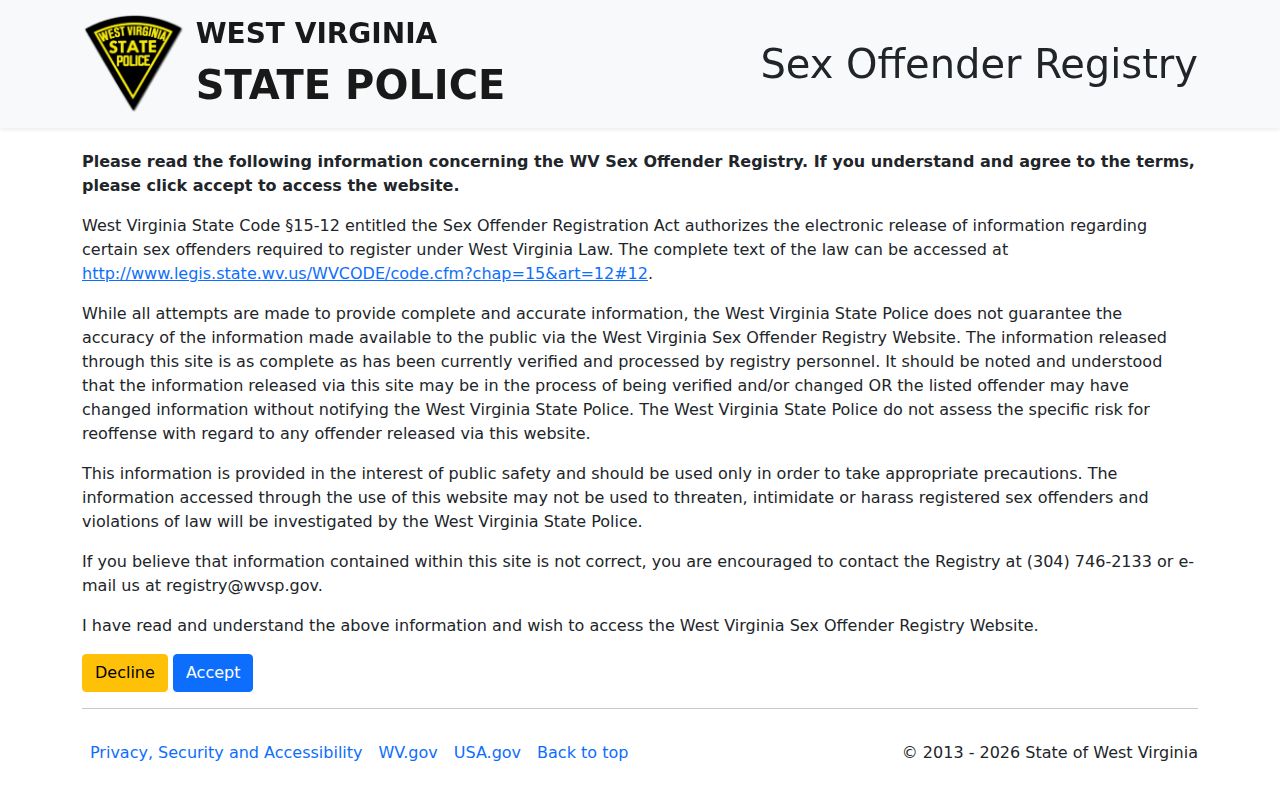
The form matters because a county filter and a text query answer different questions. A broad Grant County search can find records tied to the county, while a name search is better when identity is already known. Read the profile and its last-modified date after opening a result. WVSP warns that information may be in the process of verification or change, that a person may fail to report, and that completeness or accuracy is not guaranteed.
Grant County Neighborhood Registry Radius
The Neighborhood tab is useful when the question concerns an address rather than a known name. It asks for street address, city, a five-digit ZIP code, and a radius. Available distances are 1, 3, 5, 10, 15, and 25 miles. Grant County can be selected as an added filter, but the tool also permits all counties or out-of-state records. No map control was observed during the official interface review, so expect a radius result list rather than a pin-based map.
Start with the smallest radius that fits the safety question. Expand it only when needed. A wide circle near a county or state line may return records from places that do not match the mailing city entered, so compare the displayed residence and county fields. The lack of a result does not prove that no qualifying person is nearby. The WVSP disclaimer expressly allows for late reports, verification work, and other changes.
How to Search the West Virginia Sex Offender Registry
Choose the tab that matches the information in hand. Basic search is fast for a last name, street, city, or county. Advanced search adds separate fields and two special result limits. Neighborhood search works from an address and distance. The Internet tab checks a registered email address or username. None of these controls assigns risk, and WVSP says it does not assess a listed person's likelihood of reoffending.
- Open the WVSP registry and accept its conditions of use.
- Choose Basic, Advanced, Internet, or Neighborhood based on the fact being checked.
- For a county-wide query, select County, enter Grant as the search text, or choose GRANT from the county list.
- Open the matching profile, compare identifiers, and note the last-modified date before acting on the information.
| Field or Control | Type | Required | Options or Format |
|---|---|---|---|
| Basic Search By | Dropdown | Yes | Last Name, Street Name, City, or County |
| Basic Search Text | Text | Yes | Maximum 200 characters |
| Basic County Name | Dropdown | No | All counties, 55 named counties, or out of state |
| Advanced Last Name | Text | No | Maximum 100 characters |
| Advanced Street Name | Text | No | Maximum 100 characters |
| Advanced City | Text | No | Maximum 100 characters |
| Advanced County | Dropdown | No | All counties, 55 named counties, or out of state |
| Limit Results | Radio | No | Wanted only, sexually violent predators only, or no limit |
| Email or Username | Text | Yes | 1 to 255 characters |
| Neighborhood Street Address | Text | Yes in practice | Address used as the radius center |
| Neighborhood City | Text | Yes in practice | City for the address |
| Neighborhood ZIP | Text | Yes in practice | Maximum 5 characters |
| Neighborhood Radius | Dropdown | Yes | 1, 3, 5, 10, 15, or 25 miles |
| Neighborhood County | Dropdown | No | All counties, 55 named counties, or out of state |
| Tip Email | Yes | Reporter contact | |
| Tip Subject | Text | Yes | Maximum 255 characters |
| Tip Description | Textarea | Yes | Maximum 2,000 characters |
The county dropdown is optional in Advanced search, so add GRANT when a broad name could return records from elsewhere. The wanted-offender and sexually violent predator limits narrow results; they do not describe every profile outside those filters.
Correcting Grant County Registry Data
A wrong address, spelling, or profile detail should go to the WVSP Registry Unit, not to a private search service. Contact the unit at registry@wvsp.gov or 304-746-2133. State the field that appears wrong, identify the public profile precisely, and describe the source that supports the correction. The registry's Submit a Tip control is also available from a profile, but its form is designed for a tip: reporter email, a subject line, a description, and a prefilled offender SID.
Use law enforcement for an emergency, suspected crime, or immediate safety issue. For nonemergency local routing, the Grant County Sheriff can be reached at 304-257-1818. A data correction is different. WVSP is the system custodian and can review what appears in its public record. Grant County has no documented sheriff app alert or local registry correction portal, so the state registry remains the verified route. Do not confront a person based on an online entry.
Inside a Registry Profile
An inspected, anonymized WVSP profile displayed identity, residence, and offense information in one public record. It also showed a portrait and the date the page was last changed. Several fields often assumed to appear on registries were not observed: vehicles, tattoos or scars, a statute number, a federal-style tier label, and a separate compliance-status field. Do not fill those gaps from other websites or infer them from the offense narrative.
| Name and Identity | Full displayed name, date of birth, age, race, and gender |
|---|---|
| Photo and Description | Portrait, height, weight, hair color, and eye color |
| Residence | Street, city, county, state, and ZIP code |
| Other Registered Places | Owned or leased property, employer, and school entries when reported |
| Offense Detail | Conviction date, victim relationship, victim sex and age band, plus narrative offense and sentence |
| Page Controls | Last-modified date, Submit a Tip, and Back |
Match more than a name. Age, physical traits, and residence can help distinguish people with similar names. The offense narrative supplies context, but the registry does not calculate personal risk. For an underlying court outcome, use the originating court record rather than treating the registry profile as a full case file.
Grant County Searches Across State Lines
The Dru Sjodin National Sex Offender Public Website, or NSOPW, is the official federal search layer when an address or person may connect to more than one state, territory, tribal jurisdiction, or the District of Columbia. It does not replace the WVSP record for a Grant County result. Instead, it brings participating public registries into one search and sends users back to the contributing jurisdiction for record detail.
The national interface provides a useful second channel for mobile records and border-area searches. Review the official NSOPW search source when the inquiry extends beyond West Virginia.
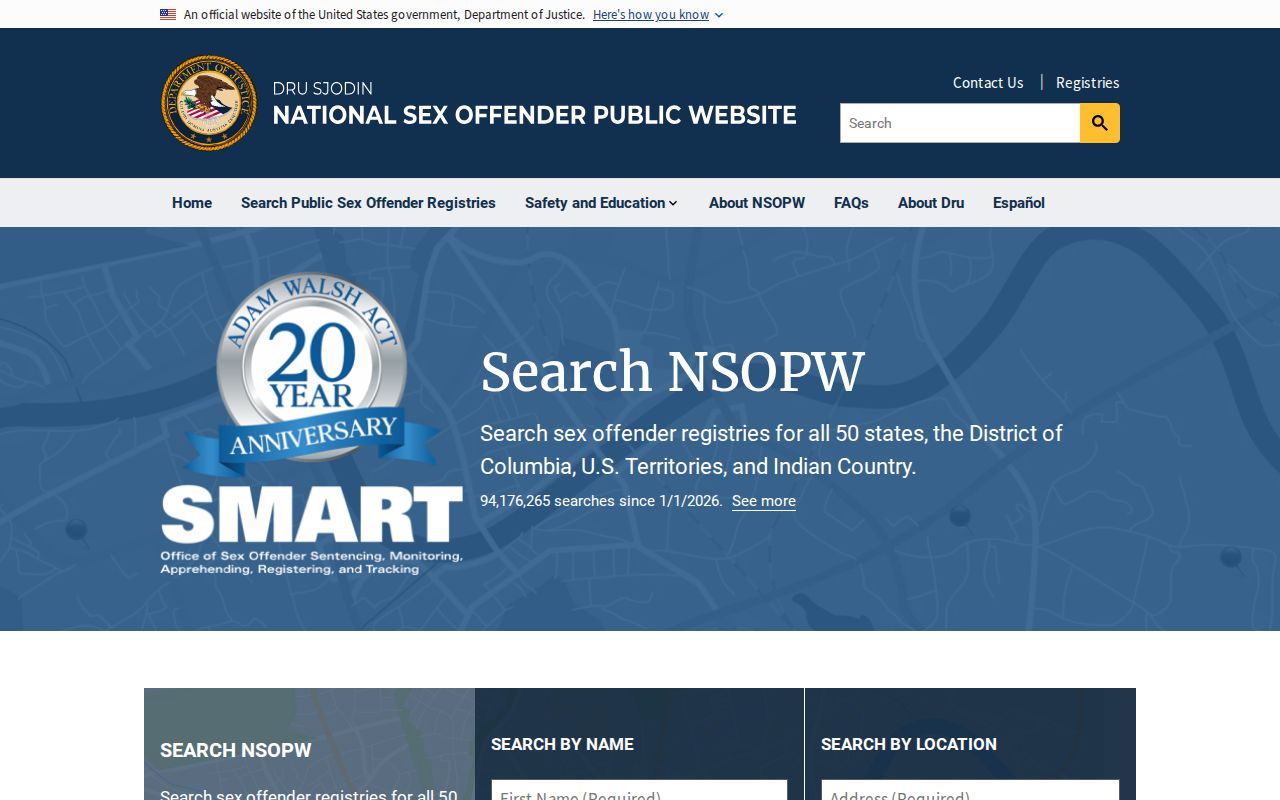
When the two sources appear to conflict, compare update dates and profile details, then contact the registry that owns the record. For a West Virginia entry, that is WVSP. A national search miss should not be used to override a current state profile.
West Virginia Registration Levels and Requirements
West Virginia does not display federal Tier I, II, or III labels on its public registry. State law instead sets a ten-year registration period for a qualifying registrant who has no lifetime condition, and lifetime registration for defined convictions or findings. The ten years begin after release from confinement or placement on probation, parole, or supervised release. Ending supervision early does not shorten that period. Section 15-12-2 also states an annual registration fee of $125.
| Public Category | Duration | Verification |
|---|---|---|
| Qualifying registrant without a lifetime condition | 10 years from the statutory start point | During the birth month |
| Lifetime condition | Life for specified convictions or findings | During the birth month unless the SVP rule applies |
| Sexually violent predator | Life | January, April, July, and October at the WVSP detachment covering the county |
W. Va. Code §15-12-4 governs duration and permits a removal petition after an overturned qualifying conviction. Section 15-12-10 governs verification. These rules explain a public category and schedule; they do not authorize adding a tier number that WVSP does not publish.
Why Grant County Registry Data Changes
Registry information is a live reporting system, not a fixed court archive. A residence, employer, school, or other reportable fact can change. Verification may still be underway, and a registrant may not have made a required report. WVSP therefore disclaims a guarantee of completeness or current accuracy. The profile's last-modified date helps, but it does not prove that every field was independently confirmed on that day.
Use the result as a prompt for prudent safety steps. For a suspected reporting violation, give WVSP or local law enforcement the profile and the specific observed fact. For a simple data error, use the Registry Unit correction route. Grant County residents should not rely on an unofficial repost, which may preserve an old version after the state record changes.
Grant County Registry Disclosure Rules
West Virginia registry disclosure does not work like an ordinary Grant County Freedom of Information Act request. W. Va. Code §15-12-5 controls public disclosure and community notification and places registry information outside the usual FOIA route. That means the fields displayed by WVSP are the proper public set. It does not follow that every item held by an agency can be obtained by asking the county for a broader file.
The state disclosure law is shown through the official source. Read the Legislature's registry disclosure text for the rules behind the Grant County public view.
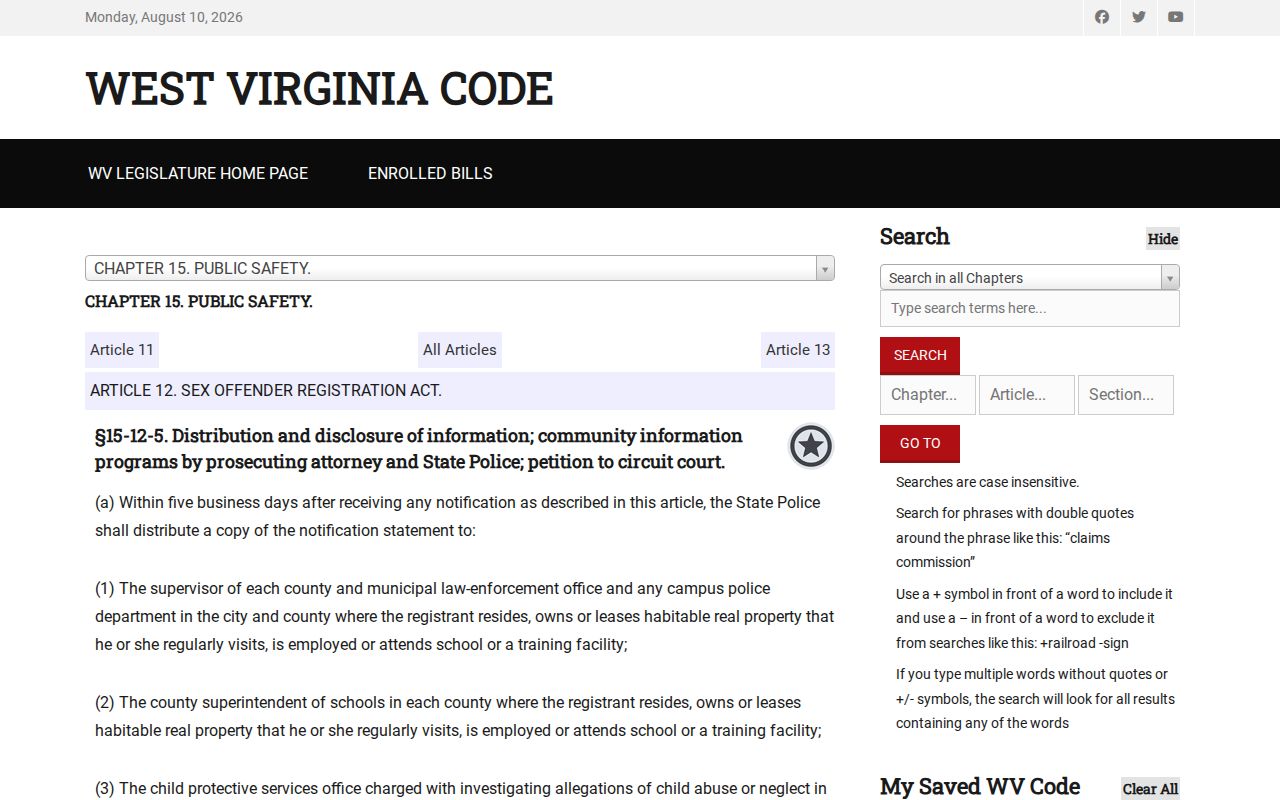
This distinction protects accuracy as well as lawful limits. Use the registry for its authorized public fields, the court for the underlying criminal case, and WVSP for a profile correction. Each office answers a different question.
Community Notification and Lawful Use
Registry information serves safety precautions and community awareness. It is not an invitation to contact, follow, expose, threaten, or pressure a listed person or household. WVSP expressly warns against threats, intimidation, and harassment. If a Grant County search raises an urgent concern, call law enforcement. If it reveals a possible reporting violation, send the facts through the registry tip channel. A profile alone does not establish a new crime or measure future conduct.
Misuse warning: Using registry information to threaten, intimidate, or harass can violate West Virginia law. Section 15-12-5 authorizes disclosure for community notification, not vigilantism.
Grant County has no verified sheriff registry app or local alert tool. Use the WVSP registry for state records and NSOPW for a cross-state check. Keep copies of relevant profile details when reporting a concern, then let the responsible agency verify the facts.